You’re making million-euro decisions based on spreadsheets
Every serious financial decision your organisation makes gets put through the wringer. Budgets are audited. Forecasts get challenged in the room. Investment proposals don’t get past the board without evidence behind them.
Energy plays by different rules.
Most organisations are still running their energy decisions through spreadsheets, exports from three different systems, and assumptions that have quietly built up over several years. The numbers look precise. Precise and accurate are not the same thing.
There’s nothing wrong with a spreadsheet, by the way. The problem is that a spreadsheet can’t tell you whether the information inside it actually reflects what’s happening in the building.
A spreadsheet can’t stand up in front of a board and defend a €5 million investment
When an organisation decides to install a heat pump, increase electrical capacity, or commit millions to energy infrastructure, the decision usually starts life as a spreadsheet that has never once been verified.
Almost nobody stops to ask the obvious question: could we actually defend these numbers if someone pushed back? If the honest answer is no, everything calculated from that point on is questionable.
A spreadsheet can be formatted beautifully and still lead an organisation to the wrong decision.
This is where assumptions get expensive
This is the moment organisations expose themselves to risk they didn’t need to take. Infrastructure gets sized for demand nobody measured. Business cases lean on information that’s incomplete. Capital gets committed before anyone has worked out what the building actually requires.
That’s not really a data problem. It’s a governance problem.
Finance has auditing, reconciliation, accountability, and controls built in as standard. Energy, too often, has a spreadsheet that gets emailed between departments.
That gap is worth taking seriously.
Evidence changes the decision
At Dublin Airport, measured operational demand came in significantly lower than the assumptions that had been driving infrastructure planning. That single change led to a fundamentally different investment decision — avoiding infrastructure the airport never needed and reducing the capital required. None of that would have been possible without replacing assumption with measurement.
Spreadsheets are a fine way to support a decision.
They should never be the evidence behind it.

What is energy accounting?
Most organisations would never approve a major financial investment using numbers that cannot be explained,...

Why organisations keep solving the wrong energy problem
Most energy strategies start with a solution already in mind. A heat pump. More electrical...

Poor energy data is exposing organisations to financial and compliance risk
Energy data used to sit in the background, collected and reviewed occasionally, with little impact...
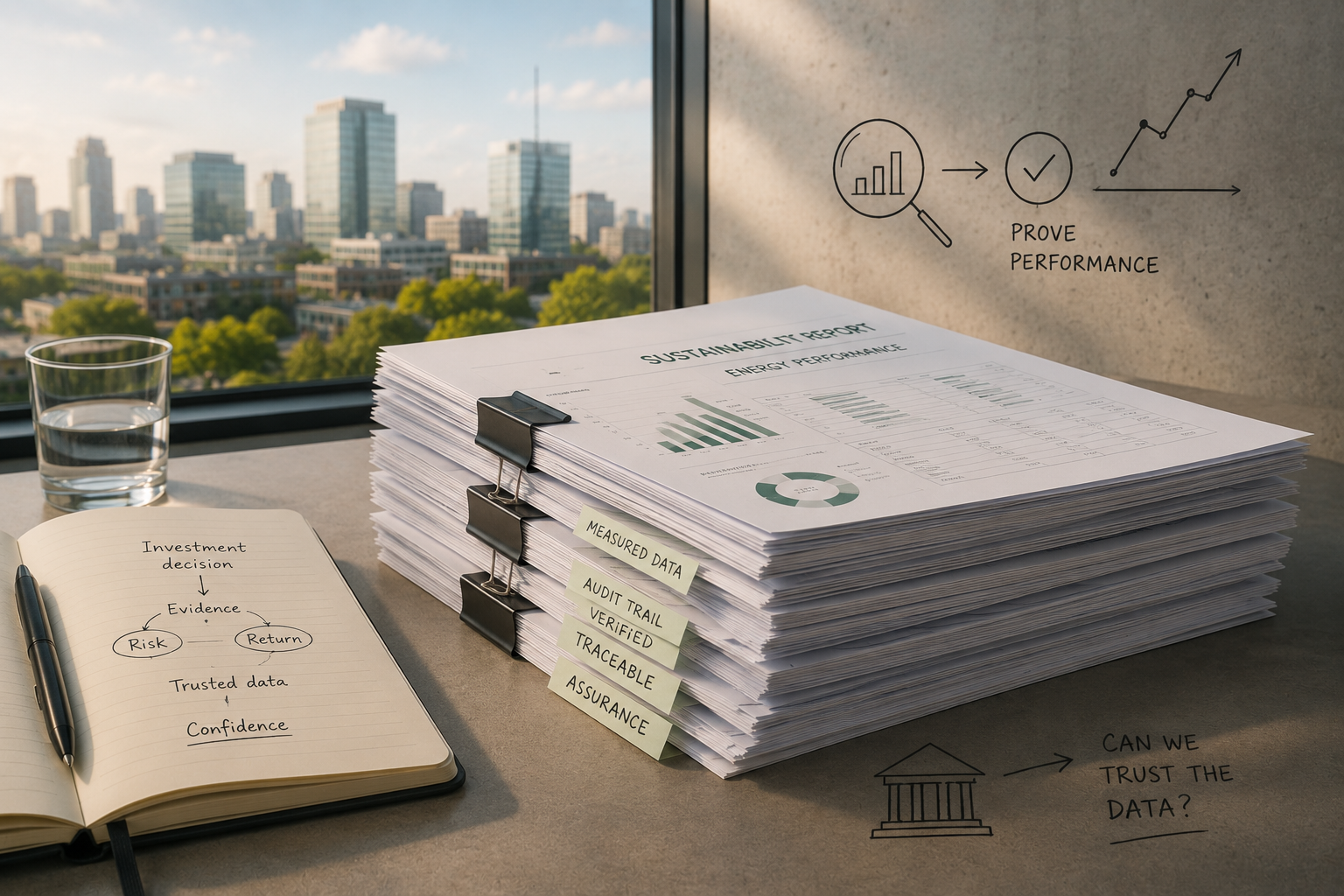
Want investment? Be prepared to prove your energy performance
There was a time when sustainability reporting was largely about demonstrating good intentions. That time...